 EN


PET preforms are not merely simple semi-finished blanks for stretch blow molding — they define the upper limit of what your finished beverage bottle can achieve. Every property locked in during injection molding, from wall thickness distribution and intrinsic viscosity to crystallinity and residual stress, carries forward through reheating, stretching and blowing. Even small inconsistencies at the preform stage will surface later as clarity issues, leakage, burst failure, poor shelf life or high scrap rates on your filling line. For water, carbonated soft drinks, juice and iced tea producers, stable preform quality is the foundation of predictable, reliable bottle performance.
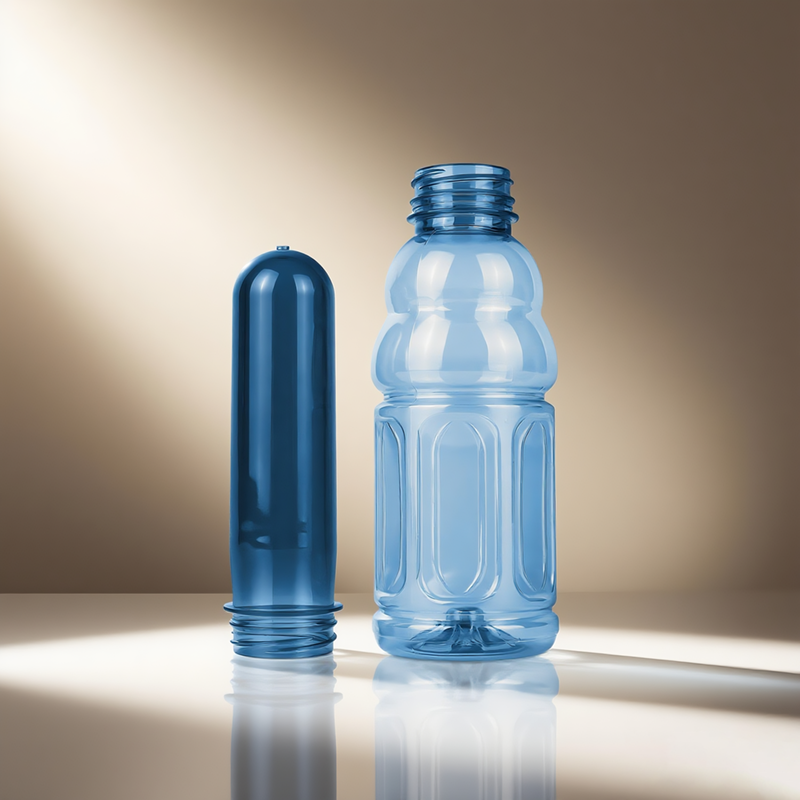
Many bottlers mistakenly treat blow molding as the only control point for bottle quality. In reality, blow machines can only work with the material structure they receive. Poor preform consistency forces constant machine retuning, drags down OEE and creates hidden defects that only emerge weeks later during warehousing or retail distribution. Understanding this upstream-to-downstream link helps brands and co-packers set clear acceptance criteria for incoming preforms and reduce costly batch failures.
Critical Preform Quality Parameters
Material Distribution and Wall Thickness Uniformity
Wall thickness profile is one of the most impactful preform specs. If one side of the preform is noticeably thicker than the opposite side, infrared heating will be uneven, and the PET will stretch differently across the bottle body. Thick zones may overheat and thin out unpredictably; thin zones may run short of material when stretched, creating weak spots prone to cracking under internal pressure.
This risk is especially serious for carbonated bottles that hold 4–6 bar internal pressure. Stress concentrates in thin or transition areas, which become crack initiation points. Bottlers monitoring PET preform quality commonly target wall thickness tolerance within ±0.1 mm for beverage-grade preforms. When this window is held steadily, blow-molded bottles achieve balanced wall mapping, lower burst failure and fewer rejects on high-speed lines.
Crystallinity Levels and Molecular Orientation
Crystallinity forms while the preform cools inside the injection mold. Too much crystallinity creates permanent haze and kills the crystal-clear look buyers expect for water and transparent drinks. Too little, and the molecular structure lacks the ordered regions needed for strong barrier performance after biaxial stretching. For most beverage applications, the sweet spot sits around 30–35% crystallinity, balancing visual clarity with oxygen and CO₂ resistance.
Molecular orientation established during injection also shapes stretch behavior. If polymer chains are randomly aligned or trapped under uneven cooling stress, the preform will not stretch uniformly. The finished bottle will show inconsistent hoop strength, irregular shrinkage after capping, and dimensional drift under warm storage. That is why quality testing must go beyond visual checks and sample crystallinity alongside dimensional data.
Thermal History and Processing Conditions
Every preform carries a thermal fingerprint from its injection cycle: melt temperature, residence time in the barrel, cooling rate and mold temperature. Overheated PET suffers thermal degradation, IV drops, and stretchability declines. These preforms feel less ductile in the oven; they stretch unevenly and often produce bottles with cloudy patches or premature rupture.
Cooling asymmetry is another hidden risk. If one side of the cavity cools faster than the other, residual stress builds inside the preform. Later, during reheating, this internal stress releases and causes warping, skewed neck alignment or uneven expansion. Even with perfect blow-machine settings, thermally unstable preforms produce inconsistent output.
Structural Performance Implications
Pressure Resistance and Container Integrity
Carbonated beverage bottles must withstand sustained internal pressure, often 6–8 bar, plus extra shock during filling, capping and palletizing. That capacity is built into the preform. Uniform material distribution lets the stretch rod and blow air spread PET evenly, creating a balanced biaxial structure that resists pressure without localized overload.
Preform defects such as heavy gate vestiges, lopsided walls or internal bubbles create fixed stress hotspots. Under repeated pressure cycling, these points fail first. Failures may not appear immediately after blowing; many only surface days later in the warehouse, making root-cause tracing harder and raising product recall risks. Consistent preform quality reduces these latent integrity failures.
Impact Resistance and Drop Performance
Drop performance matters through the whole supply chain: automated depalletizing, truck vibration, manual handling and retail shelf drops. Preforms with well-controlled crystallinity and low residual stress produce bottles that flex rather than shatter. Many beverage specs require survival from 1.2 m drop heights without bursting or leaking.
A batch of inconsistent preforms creates a wide spread of drop-test results. Some bottles pass easily; others crack at low heights. Field data from bottling lines shows that locking in tight preform specs can cut in-transit breakage by up to 40%, lowering product loss, customer complaints and reverse logistics costs.
Barrier Properties and Product Protection
Gas Transmission Characteristics
Barrier performance directly controls shelf life. For carbonated drinks, CO₂ loss over time flattens the beverage; for juice and sensitive drinks, oxygen ingress triggers oxidation, color shift and off-flavors. The final oxygen transmission rate (OTR) and CO₂ permeability depend heavily on how uniformly the PET orients during blowing — which starts with the preform’s material consistency.
A common benchmark for carbonated packaging is below 15 cc/bottle/day CO₂ loss. When preform thermal history varies from shot to shot, finished bottles show wide scatter in barrier values. Some stay within shelf-life targets, others lose carbonation too quickly. This inconsistency creates unpredictable quality and uneven consumer experience across production runs.
UV Protection and Light Stability
Light-sensitive beverages such as some juices, dairy drinks and functional drinks need protection from UV radiation. If UV additives are used, they must disperse evenly during preform injection. Poor dispersion or uneven crystallinity creates patchy light transmission: some bottle areas block UV while others let damaging light pass through.
Even for plain bottled water, optical consistency is a brand issue. Hazy streaks, cloudy bases or uneven gloss come from unstable preform cooling and crystallization. Consumers interpret poor clarity as low-quality product, so preform QC directly supports shelf presentation as well as chemical stability.
Processing Efficiency and Production Optimization
Blow Molding Performance Consistency
High-speed rotary blow machines are tuned for a narrow window of preform behavior. When preforms are stable, oven zones, stretch timing and blow pressure stay fixed. The line runs at target cycle time, changeovers are rare, and OEE improves. Operators do not need to reheat, slow down or babysit every incoming batch.
When preform quality drifts, technicians continuously adjust lamp power, pre-blow timing and stretch speed to compensate. Each adjustment introduces new variability. Bottlers switching to premium, consistent preforms often report 15–20% productivity gains, mostly from fewer stops and less manual intervention.
Rejection Rates and Quality Assurance
Preform defects cascade into bottle rejects: crooked necks, off-spec heights, bad sealing surfaces, thin-wall bursts and visual rejects. Inline vision systems catch some, but many latent issues slip through until lab testing or customer complaints. Upstream QC on preforms is far cheaper than sorting finished bottles or discarding filled product.
With validated preform testing, teams move from reactive end-of-line inspection toward predictive quality. If preform wall mapping, weight and IV stay within control limits, the team can confidently expect bottles to meet burst, drop and barrier specs. This reduces over-testing while protecting compliance.
Long-term Performance and Shelf Life
Stress Crack Resistance and Durability
Environmental stress cracking (ESC) is one of the most troublesome long-term failure modes. It happens when residual stress combines with beverage chemistry and warm storage. The seed of ESC is often planted in the preform: uneven cooling, high gate stress or material inhomogeneity creates locked-in stress that does not disappear during blowing.
High-quality preforms are engineered to minimize trapped internal stress. That makes finished bottles much more resistant to slow crack growth over months of storage. This is especially critical for products with long shelf life and hot-climate distribution.
Dimensional Stability and Shape Retention
Bottles must hold their shape after capping, during pallet stacking and through temperature swings. If molecular orientation is uneven, bottles shrink unevenly, lean, bulge or distort. Distorted bottles cause labeling misalignment, unstable pallets and jams on filling lines.
Consistent preform quality preserves design geometry throughout the product lifecycle. Labels sit flat, stacking performance stays predictable, and the package matches the brand’s approved visual standard in every retail channel.
FAQ
What specific preform defects most commonly cause bottle performance issues?
The highest-impact defects are uneven wall distribution, excessive gate vestiges that act as stress risers, inconsistent crystallinity causing haze, neck ovality and dimensional drift beyond ±0.05 mm. These defects lead to uneven stretching, weak pressure points, poor sealing and unpredictable failure during filling, transport or storage.
How does preform storage and handling affect final bottle quality?
PET absorbs moisture from humid air. If preforms pick up moisture before blowing, hydrolysis occurs during reheating, dropping IV and making the material brittle. Wide temperature cycling also shifts crystallinity and residual stress. Best practice is dry, stable storage, typically below 65% RH, away from direct heat and mechanical abrasion, until feeding into the blow machine.
What testing methods best predict bottle performance from preform characteristics?
The most useful suite combines gravimetric weight checks, ultrasonic wall thickness profiling, dimensional gauging, DSC crystallinity testing and IV measurement. The gold-standard predictive test is blowing sample bottles from each preform batch and running burst, drop and barrier validation. This links preform lab data directly to real-world bottle performance.
Can preform quality variations be corrected during bottle production?
Minor deviations can sometimes be offset by adjusting oven zones, stretch timing or blow pressure. But fundamental issues — poor wall distribution, unstable crystallinity, degraded IV and trapped residual stress — cannot be fixed downstream. Blow molding only rearranges the material you start with. The most reliable strategy is to lock in strict preform quality standards at the injection molding stage.
