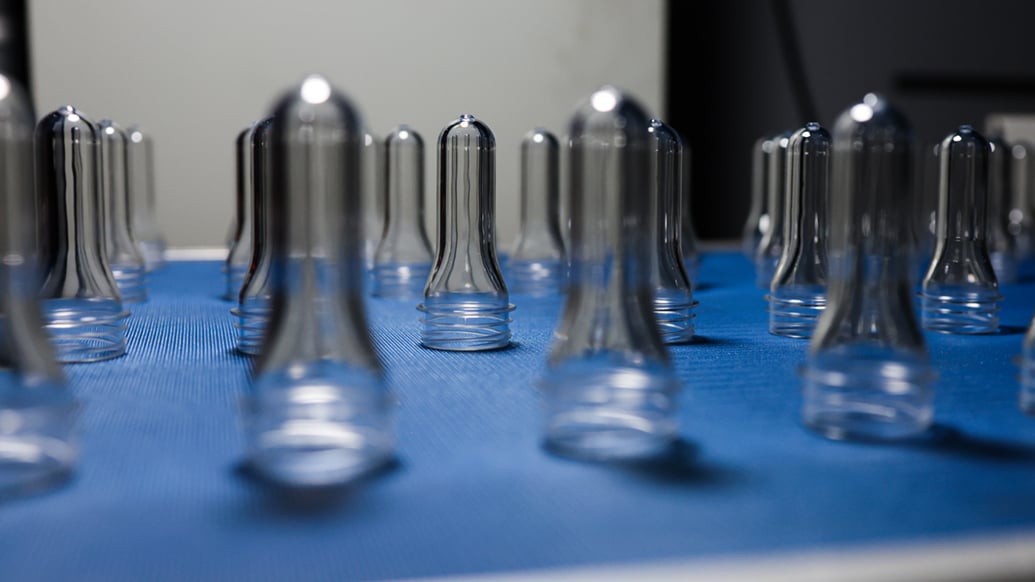
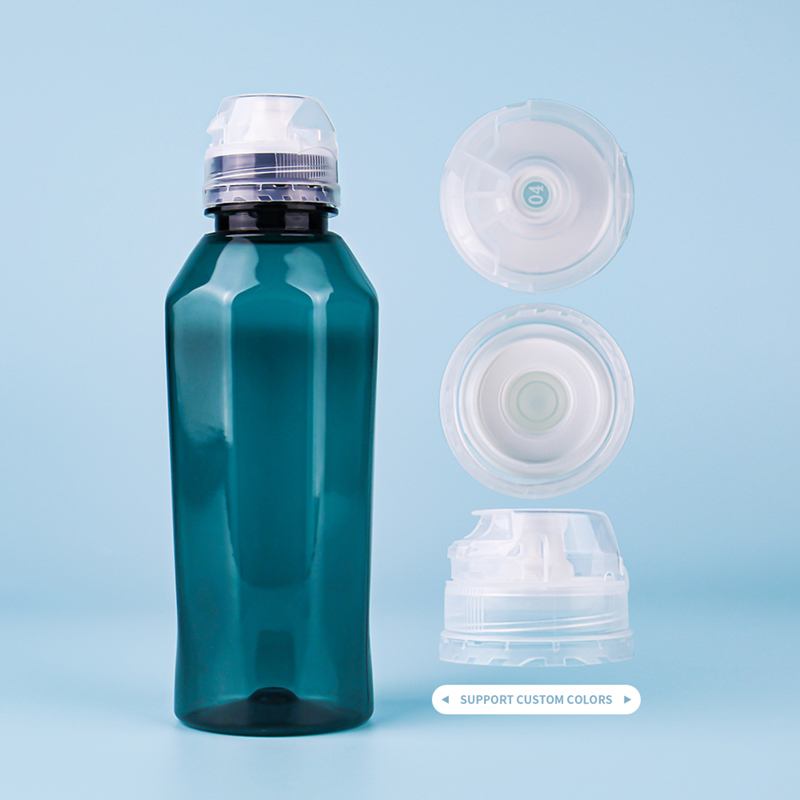
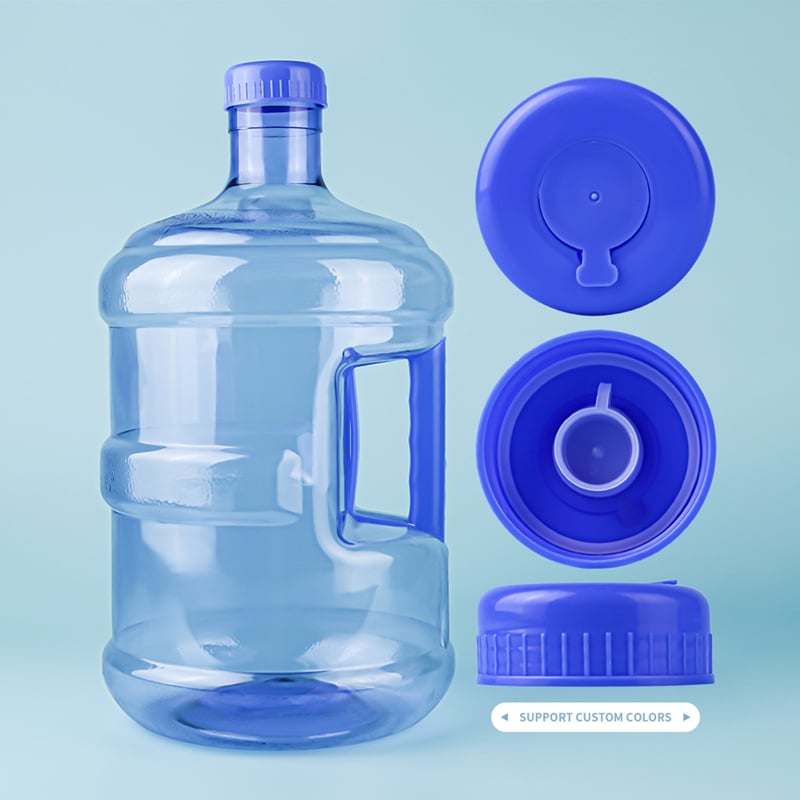
Stretch blow molding is the most critical stage in PET container manufacturing, fundamentally a complex process of molecular chain orientation and crystallization. This process transforms pre-injection molded, amorphous preforms into biaxially oriented containers with high strength, excellent clarity, and superior barrier properties through precise thermal and mechanical stretching. Achieving superior manufacturing outcomes requires a systematic understanding of the entire knowledge chain, from polymer physics to automation control.
I. Material Science, Thermal History, and Storage Dynamics
PET Structure and Blow Molding Suitability:
Polyethylene Terephthalate (PET) is a semi-crystalline polymer. Successful blow molding depends on heating the material into its ideal rubbery state within the specific temperature window (between the Glass Transition Temperature, Tg, and the Crystallization Temperature, Tc), allowing for molecular orientation. The oriented molecular chains are "frozen" upon cooling, significantly enhancing the material's mechanical strength and creep resistance.
Raw Material Selection and Quality Control:
Virgin Material: Must use dried, bottle-grade PET pellets with a moisture content below 50 ppm. Excess moisture causes hydrolysis during heating, severing molecular chains, significantly reducing Intrinsic Viscosity (IV), and resulting in brittle bottles.
Recycled Material (rPET): When using food-grade rPET, beyond controlling proportion and number of recycling cycles, close attention must be paid to the IV value match and color difference versus virgin material. Incompatible rPET can cause "streaks" or "mottle" appearance defects and create microscopic stress concentration points.
Underlying Principles of Preform Storage:
Stress Relaxation: Injection-molded preforms contain frozen orientation stresses and volumetric stresses. Storage for over 48 hours allows these stresses to fully dissipate through micro-Brownian motion of polymer chain segments.
Preventing Pre-crystallization: If storage ambient temperature is too high (e.g., consistently above 40°C), it can induce uncontrolled pre-crystallization. This causes surface "whitening" during reheating and makes the preform difficult to blow.
II. Thermodynamic Principles of Heating and Cooling Systems
Synergistic Strategy of Multi-Zone Heating: Modern ovens with multiple independently controlled heating zones (typically 6 to 10) are core to achieving precise heating.
Top, Middle, Lower Zone Control: Enables differential heating for specific preform sections. The Top (neck finish) requires lower temperature to prevent deformation of this already crystallized structure. The Middle (body) requires the highest temperature for optimal stretchability. The Lower (base) needs moderate temperature to allow base material to stretch without becoming excessively thin.
Infrared Radiation and Hot Air Circulation Synergy: Far-infrared radiation provides penetrating heat, affecting temperature deep within the preform wall. Forced hot air circulation balances surface temperature, compensating for variations caused by radiation distance and preform shadowing.
Advanced Applications in Cooling Science:
Internal Cooling: Beyond liquid nitrogen or cold, high-pressure air, more advanced systems use double-walled molds with a cooling medium (e.g., chilled water) circulating through the cavity, enabling rapid heat extraction from the inside out.
Crystallinity Control: The cooling rate directly determines the final crystallinity of PET. Rapid cooling (quenching) suppresses crystal growth, yielding high clarity. Slow cooling allows large spherulites to form, increasing haze and brittleness.
III. Closed-Loop Control of Process Parameters and Defect Mapping
Stretch Rod Motion Profile Optimization:
The stretch rod is not just a physical stretching tool; its velocity profile is key to controlling material distribution.
Velocity Profile: An "S-curve" (Slow-Fast-Slow) is often optimal. Initial slow speed ensures thorough stretching of the preform base. Mid-stroke fast speed enables efficient molecular orientation. Final slow speed prevents impact with the mold base, avoiding base pinching or thickness variation.
Pressure Timing Model for Pre-blow and Final-blow:
This is the core of the bottle's "forming story."
Pre-blow: Triggered just before the stretch rod contacts the base, creating a "gas cushion" to prevent the parison from sticking to itself. Insufficient pressure causes body dents; excessive pressure can rupture the parison.
Delay-blow: A brief pause after the stretch rod reaches its endpoint but before final-blow, allowing material final relaxation and distribution under low pressure, improving wall thickness uniformity in shoulders and base.
Final-blow: Applies peak pressure (typically 25-40 bar) to press the material against the mold cavity at high strain rates, replicating fine surface details and instantaneously setting the shape via cooling.
Root Cause Analysis and Countermeasures for Typical Defects:
Defect Phenomenon |
Potential Root Cause(s) |
Systematic Solution(s) |
Whitening at Base |
1. Pre-blow too early / Excessive pressure
2. Preform base temperature too low
3. Stretch rod speed too fast |
1. Delay pre-blow timing, reduce pre-blow pressure
2. Increase temperature in lower oven zones
3. Optimize stretch rod velocity profile |
Body Wrinkles |
1. Pre-blow too late / Insufficient pressure
2. Overall or local preform temperature too low
3. Mismatch between stretch rod speed and air pressure timing |
1. Advance pre-blow timing, increase pre-blow air volume
2. Check and calibrate temperature in relevant oven zones
3. Re-synchronize stretch rod and air pressure sequence |
Internal Pearlescence / Haze |
1. Material over-stretching (especially in thin areas)
2. Material contamination or degradation
3. Improper cooling rate causing micro-crystallization |
1. Reduce temperature in oven zones corresponding to thin walls
2. Check material purity and dryer performance
3. Optimize internal cooling pressure and duration |
Eccentric Base |
1. Misalignment between stretch rod and mold
2. Uneven clamping force
3. Excessive clearance between preform neck and clamp |
1. Perform regular concentricity alignment of mold and stretch rod
2. Inspect and maintain clamping system
3. Check preform dimensional tolerance and clamp wear |
IV. Smart Manufacturing and Sustainability for Industry 4.0
· Data-Driven Process Optimization:
MES (Manufacturing Execution System): Integrating an MES allows real-time monitoring and recording of production data (cycle time, heater temperatures, pressure profiles, etc.) for every machine and mold, enabling full traceability.
Machine Learning Application: By collecting vast amounts of process parameter and final product quality data, AI models can be trained to predict optimal process windows and even auto-adjust parameters preemptively before defects occur.
· Mold Intelligence and Rapid Response:
Individual Mold Temperature Control: Integrating independent, precise temperature control units for different mold sections allows for differentiated cooling strategies, enabling finer control over crystallization and shrinkage.
Quick Mold Change (QMC) Systems: Using standardized interfaces and hydraulic locking, product changeover times can be reduced to minutes, significantly enhancing production flexibility.
· Energy Saving and Carbon Neutrality Pathways:
Energy Recovery Systems: Harvesting heat generated by the blow molding compressor for preform pre-heating or space heating can reduce energy consumption by over 20%.
Lightweighting Design: Using CAE software for topology and wall-thickness optimization allows for continuous reduction of bottle weight without compromising strength, reducing plastic usage at the source.
This extensively expanded version aims to build a comprehensive knowledge framework spanning from microscopic material science to macroscopic smart manufacturing systems, hoping to provide profound reference value for you and your team. I am ready to provide further details on any specific sub-topic upon request.
 EN
EN

 Hot News